Showing posts with label UPS University. Show all posts

January 13, 2012

3phase Power Misconceptions: Circuit Watts

Recently, we have been recommending more 3phase power solutions for people.  Frequently, the mere mention of a 3phase UPS creates fear and confusion.  Part of the problem is that 3phase UPS units were expensive to buy and even more expensive to maintain.  We still have business affiliates that make most of their money on service contacts on these older beasts.

Today's 3phase is cheaper, expandable, and near maintenance free.  But before you make the jump to the Symmetra PX 40... lets consider one aspect of 3phase.... CIRCUIT WATTS

  • 3phase is a method delivering power... what it ultimately delivers is still watts.  There is no difference between a 3phase phase watt and single phase watt.
  • Since watts are a result of volts x amps.... if you need more watts you must increase voltage and or amps.
  • And since your amperage is fixed at your panel or building, upping voltage is the best way to get more watts.
  • But if you are already running at high voltage and amperage is maxed... your only option is to goto 3phase.
Consider a 30amp circuit to a rack.  Notice how upping the voltage and phase delivers more watts or power.
  • At 120volt... your 30amp circuit provides 2.88kw
  • At 208volt... the 30amp circuit provides 4.99kw
  • At 3phase 208v... that same circuit provides 8.64kw
Just this one aspect gives you a glimpse of why 3phase power is seen by IT providers as the more effective way of delivering the wattage you need to your IT system.


December 29, 2011

U P aSked: Can I use a SUA3000RMT2U on a regular home 240VAC without damaging the UPS

Danger Will Robinson.. Danger !

High voltage is often causally described as 208, 220, 230, 240 and even 250volt.  But as previously mentioned, high voltage in the US only comes in two nominal flavors:  208v and 240v.  

Recap on Voltages
208volt is derived from commercial 3phase power (though it actually single phase).
240volt is derived from some commercial 3phase power, smaller commercial locations AND more commonly found in people's home.

Recap on UPS Voltage Signatures
Nearly every manufacturer (EXCEPT APC) make units that are good for all types of US and in many cases international power.
UPS will output what the input power is (eg 208v in > 208v out).  And will go to protect mode if the input power is off or the voltage is out of range.
For this to work, you must make sure your UPS can output the voltage you want.  Either automatically or pre-set in the configuration

THE APC EXCEPTION
Most SmartUPS units just output 208volt.   So when you give it 240volt, it will think you are getting a surge and trim the voltage down back to 208v.  Or as APC says...
if you will use it on a much more higher voltage the unit will run online but will be on AVR Trim state which in the long run would damage the mechanism that corrects voltages.

Bottomline... if you need 240volt for a home server UPS... look for our listings with the 200v+, 240, or 208/240v icons.  Sadly that SUA3000RMT2U is not one of them.


July 26, 2011

Efficiency in UPSes - Part 2

Continuing from last post on Efficiency...

Besides Power Factory Efficiency, the other type of Efficiency is Topology Efficiency.

This type of Efficiency is more related to energy savings, but honestly more gimmicky as manufacturers tout their green credentials.

Simply put, Topology Efficiency is the amount of energy used to operate the UPS.  Lets recall Topology... Its is the method of providing backup power.  Online Topology, is simply that its allways online.. allways giving you clean power.  Line Interactive Topology uses a 'switch' to turn on the UPS power if something in the line goes bad.  Obviously, Online - since its always on - will use more energy than a line interactive that just turns on when needed.


So line interactive UPSes are more efficient than online types can ever be.   Within the Line Interactive model mix, there are a few super efficient models.  The APC 5th generation units, (like the 200v) dont switch over to the energy intensive UPS power, unless its really necessary.  Some sort of magic corrects alot of the minor power problems without energizing those line interactive transformers.  Older units, didnt really care, and just switched over - saying to hell with a few watts.

And thats the problem... this super efficient line interactive UPS like the 5th gen APC save so little power, thats its kind of stupid.  The idea that saving of 5 kWh ($1) a month when your server room is set at 60 degrees and you are running 10,000 watts of servers is pointless.  Its like ordering a Diet Coke with a Bacon Double Big Mac, Fries, Milkshake and a bucket of lard.

Bottomline, the Topology of the UPS dictates its efficiency by determining how often the unit runs.

July 22, 2011

Efficiency in UPSes - Part 1

Efficiency is a great buzzword today, but has several meanings in the UPS world.  None of the definitions reflect what most people think of when they buy fuel efficient car, or energy efficient light bulb.

Definition 1 - Power Factor Efficiency
As I have said before, UPSes are sized in Volt Amps (VA).  While the actual Wattage is usually a factor of that VA, depending on the UPS.
A 1000va UPSes can offer 900, 670, or even 500watts, depending on its Power Factor efficiency .  Larger and even more expensive units can have the same apparent low efficiency.  The $3500 SURTD5000XLT has a 70% Power Factor Efficiency, delivering 3500watts per 5000va unit.   The MGE 5kva unit is really efficient in Power Factor, as it delivers 4500watts per 5000va unit.  Whereas, the Symmetra PX UPS is 100% efficient, delivering 10kw per 10kva.

Bottomline, while this is the most important spec in UPSes, the lower power factor efficiency doesn't necessarily mean that a unit is wasting energy like our common sense of efficiency..

July 20, 2011

When a Watt is not a Watt

As mentioned before, UPSes are rated in VA or volt-amps, which is similar to Watts. But, power supplies, speakers, etc are also rated in Watts.

The problem is that these two Watt metrics dont correlate to each other.

Example 1:  Dell's Poweredge T710 advertises two 1100watt Power Supplies, but according to APC, uses only 694watts.

Example 2: Dell's m1000e Blade Server can hold six 2700watt Power supplies (16,200watts?), but uses only 4100watts.

Bottomline, like speakers, manufacturers use "Wattage" to imply the "mightiness" of a unit.  Your desktop that has a 500w neon, water cooled power supply, barely uses 150watts, but 500watts sounds cool.  Just know that  many times these are Marketing Specs and not electrical specs.


When sizing UPS units, a simple trick is to look at the equipment's plug.  The load cant be any more than 80% of the plug.  So a blade server with a C14 12amp outlet, cant be any larger than 1150 watts.

February 27, 2011

Most read and commented posting (About Generators)

To be honest, as you may recall, I asked only for this blog not to be a dry as the dryer lint blog.  (which seems to have disappeared like that lost sock)

So its sort of surprising, that so many people turn to this Blog.  And what most people want according to Google statistics, at least on this blog, is facts about Generations and UPSes

So while I prepare a treatise on this this subject for my 150th Blog post coming out next week... let review what I have said so far....
http://webobups.blogspot.com/2010/10/when-you-need-online-upses.html
http://webobups.blogspot.com/2010/09/dream-rack-visualized.html
http://webobups.blogspot.com/2009/10/dumptruck-of-batteries-or-generator.html
http://webobups.blogspot.com/2009/05/5000-upsgenerator-solution-for-server.html
http://webobups.blogspot.com/2009/05/upses-and-generators.html

February 19, 2011

More Sizing UPS challenges

Here is another case of nameplate sizing of equipment.  
I got a request for a UPS to power a fridge that uses 7.5amps that will last 4 hours.
7.5amps times 120volt is 900volt amps or va.   But thats not the whole story.....

Step one is to understand the amperage value and its meaning for the size of the UPS.   There are 4 "types" of amperages
  • FLA or full load amps or nameplate amperage  (this is usually on the equipment by the manufacturer)  It is used to size the circuitry.   That amperage never happens in real life.
  • SLA or starting load amps or the peak load that occurs just briefly during startup (depending on the motor, this can be 2 to 10 times the FLA)
  • RLA or running load amps  (this is the average amperage during operation)
  • RMS Amps or Observed amps  (this is when someone actually measures the amperage during the equipment's operation)
So,  7.5amps  is probably the FLA and the SLA on a new high efficiency equipment is about 15amps. (15a x 120v = 1800va).  So any 3000va UPS will work 

Step two is to understand the actual load over the 4 hour outage period.  Fridges cycle on and off, so getting an observed amperage is critical.  Factoring in the duty cycle of on and off over a 4hour period suggests the RLA is about 4.5amps.  Converting to wattage, suggests this fridge uses 430 watts.

Bottomline, left to his devices he might of gotten a 900va UPS with a trunk of batteries, but by understanding is real load meant he got what he needed for about half the price.


February 15, 2011

Sizing UPSes for non computer loads

Sometimes, we get a request to suggest a UPS based on model numbers.  Other times we get specs or competing bids.  Then occasionally we get someone that knows just enough to be dangerous....

This guy wanted a UPS for his two computer controlled lathes.  The nameplate on each lathe motor was 9.5amps at 208volt.  So he asked for our APC 5000va UPS since the total VA or volt-amps was 3952.  Fortunately he shared his purpose before we shipped it to him.  Why?

a ) 19amp x 208volts is indeed 3952 volt amps, but that is based on FLA or full load amps.  Lathes have motors and have a startup amperage of 2-5 times the FLA that must be considered in the UPS
b)  the computer lathe had other components, not just the main motor.  Displays, servos, etc, dont take up too much power, but must be included in load calcs
c)  both motors could be starting at the same time, so its possible to have extended startup amperage.
d)  VA isnt the same as wattage. On non computer loads is very important to understand the factors that influence wattage.

So, I am pretty sure the 5000va unit would not have met his needs, because each unit probably demands 20amps to start, meaning 40amps potentially.

Our solution, was to a) get the real startup amperage using a MinMax multimeter {peak 14.6a}  b) sell him two 3000va ups units so as to limit the chance of dual startup and c) switch to Powerware UPS system since they often can handle 125% of load for a brief period.

Bottomline,  even if you have been told about a certain UPS, feel free to ask for our opinion.  We want you happy and your equipment working well.

February 11, 2011

All plugs are created equal and have certain inalienable rights....

I got this question today... and freaked out!
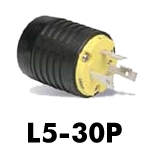
We upgraded our server wiring from 120volt to 208volt.  I want to buy a 208volt UPS.  But, since I didnt change all the plugs, I wondered if you can put a L530P on the 208volt UPS?
L5xx is a NEMA designation for 125volt circuitry.  As I mentioned before, NEMA plug designations allow people to look at a device and know the voltage for it.

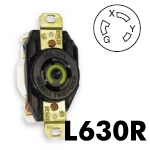
So, when someone asks me to put a L530R (Locking - 3wire 125volt - 30amp - Receptacle) on a their new 208volt system, I freak out.  L5 is a 125volt, L6 is for 250volt.

True on the L5 and L6.... the wire, prongs, cord, etc are all rated for 250volt, so its not going melt.
But, if you sell or move that unit, someone will be able to plug that 208volt unit into a 120volt L530R outlet and be disappointed.

I know plugs, devices, and electricians are expensive, but put the proper class of plugs on a unit.

February 8, 2011

Are you some type of L530P preacher

A potential customer called me out on a what he saw was an obsession with the L530 Nema designation. (just talked about NEMA plugs a few days ago here)

He noticed that nearly every 2200va UPS has a recommended L530P as the input plug on my website.
As a possible member of the dreaded Plug Police, he reminded me that it was illegal to put a 30amp plug (which is what a L530P is) on a UPS rated for 20amps.  And that no manufacturer recommends this. Even though he called before 8am, I tried to politely reminded him of the tag at the bottom of every listing.
Input plugs changed at no charge
So 1) Its not an obsession, more like a  compulsive preoccupation to have all server rooms use dedicated 30amp outlets for the UPSes.

If I give you a L530P plug on your UPS that means you will need to have a 30amp receptacle to use it.  And a 30amp receptacle is a good thing because: the presence of a 30amp outlet in your server room means your probably have a modern and safe electrical system.  Thats because if you have a 30amp receptacle you specifically asked for it.  Its not ever put in voluntarily by a low bid contractor. And when he put it in it didn't get spliced from another circuit, since there isnt any 30amp 120volt circuits wandering around.  And 30amp outlets typically weren't installed 20 years ago, which means the outlet will be modern and safe and probably up to code.

And 2) Its not illegal... maybe it is in Russia... This isnt Russia?
Ahh, Danny, this isn't Russia. Is this Russia? This isn't Russia, is it?

Amperage designations and related circuit breaker protection is what must be followed.  A 30amp outlet must have #10 wire supplying the receptacle.  A 30amp cord cap (L530P) must have #10 wire on the cord.  True, putting a 30amp cord cap on #12 wire is bad, but if the UPS has a 20amp input circuit breaker on it, it doesn't really matter

Bottomline, I like to put L530s or everything to make it easier.  Your IT rooms are complicated enough.  If everything is 30amp your wont have to keep changing 520s, L520s, and L530s around as you change and upgrade equipment.

February 7, 2011

L5, L6, L7, EL-Libre... plug designations

In order to prevent us electricians from using terms like "the outlet with a t socket,"  "a monkey face," or "Looser head", the. National Electrical Manufacturers Association created a hierarchy of devices with number designations.  Every device has a name that designates its wiring style, amperage, and type of device.
 

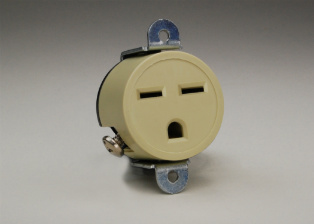
Your typical home outlet is called a 5-15R.  5 - meaning 125v 3wire L+N+G (line, neutral and ground) - 15 meaning - 15amp - Receptacle.  Adding an L to the terminology, means that it is a locking or "Twist Lok" device.  L5-30P means Locking - 125v, 3 wire L+N+G - 30amp - Plug.  There are 20 or so wiring styles and many combinations thereof.

What helps us electricians is that each designation has different contact blade widths, shapes, orientation, and dimensions that are unique to that  particular voltage, current capacity, and grounding system.(1)

So a L5-20P cant fit into a L6-30R.  Being that one is 125 volt and the other 250 volt, thats a good thing.

The other benefit is that we can look at the equipment's plug and quickly determine the voltage.  

Bottomline, you dont need to learn all the NEMA subclassifications to discuss your UPS power needs, just know that I will always refer to devices not by crazy descriptive name, but by their NEMA name.  And my most common Nema devices are here

February 1, 2011

Split Phase UPS Units... the UPS to power your subpanel

Awhile back I wrote about a customer looking for a split phase UPS.
"75mins saved hims 75%"

In that post, I mentioned how in many cases the need for a 4 wire or "split phase" UPS is unnecessary if all you need is 120volt outlets.  (Better to buy a step down transformer or re-evaluate your low voltage needs)

The only application where a split phase UPS is useful is when connecting to a panel.  Your electrical panel, either 120/240 or 120/208v is a 4 wire system.  Two wires carrying current called "hots", a ground, and a neutral.  But nearly every UPS is a 3 wire system (2 hots +G), which causes a problem

The solution in most cases, is to add a transformer (xf5iso) that outputs a fixed neutral creating 4 wires (2 hots + N + G).

However, a more expensive option is to buy a UPS that has the separate neutral system built in to its 3U frame.  These Smart UPS RTD-P units take in 4 wires and output 4 wires.

We finally have our first one and while it is still expensive, its just a bit more than buying the transformer separately.  The 693p3.

January 25, 2011

What does refurbished really mean

Even though I just talked about the need for clear definitions, defining refurbishment in anything other than a grey nebouis concepts, would be counter-productive.  The reason is 90% of what we sell is "refurbished ."  Hell, I even say our rack rails are "refurbished "

In a technical sense, refurbishment means... used computer equipment that has been restored to like-new working condition


At GreenlightUPS, refurbished means... not factory new, but 100% functional with new batteries.

This vague definition can include: never used open box items to well used items. Cosmetically, it can include a mint looking 1998 model UPS to a beat up 2010  model.  Either way, our techs test the item, clean or repair cosmetic and internal components, and install new fresh batteries.

What if I care and prefer a never used open box item to an Ok looking older unit?

Its easy, all the units we sell were released in a fairly tight production window.  Models made today werent made 6 years ago.  So a Powerware 5135 (p5392v) released in 2010 probably is a customer-return or damaged unit rather than an off lease item... meaning its probably unused.  A SmartUPS 3000 3U (303) from 2000, probably has been well used, but fully restored.  Thats why the Powerware is $800 and the SmartUPS is $400

Bottomline, call us anytime and we can find the right unit for your needs.  Our inventory turns over very fast, so we can always find what you need.


January 24, 2011

When SMART is not so smart

It seems like everyone uses the term Smart UPS.

APC owns the trademark, but Tripplite uses SmartOnline, Cyberpower uses Smart App, and Powervar uses ACE Smart in their UPS brands

But does the term Smart really mean.

To some, Smart means the ability to interact with the UPS.  But some even APC Smart UPS units, dont have this feature. And even you accept this definition, nearly every UPS interacts through a computer.  So unless everyone is exceptionally gifted, this definition doesn't work.

To me Smart should mean a better UPS: interactive, responsive, cleaner.  Features like communications, voltage trim, surge suppression and pure sine wave should be in a smarter UPS.   APC for the most part follows this.  All the APC Smart-UPS unit have these features, except the crappy square wave Smart UPS SC and the non Network management Smart UPS 420.   Tripplite and Cyberpower dont seem to follow the sine wave rule as Smart VS units and Smart App both are square wave.

Bottomline, since the definition isnt really clear, avoid using or paying any attention to the term.  Its a fluff word, like adding the word Hot toWings.

January 21, 2011

He is a Swell Wink, even if his Glitches give me Saggy Bumps

Swells, Winks, Glitches, Sags, Bumps.. are terms to describe electricity... but did you know that the engineers at IEEE actually have engineered official terminology for power problems.  There are five problems:

  1. Transients
  2. Interruptions
  3. Sags
  4. Swells
  5. Waveform distortions
Mercifully, a smart battery backup unit can address all five.  APC's interesting white paper covers these power problems and some solutions.
Click for Larger View

Looks like APC is quietly pushing those Environmental Probes as a solution to #1 .... I personally would recommend a good surge suppressor instead of adjusting the humidity in the room.

January 16, 2011

KnowUPS - Getting More from your UPS: Issue I - EPO

EPO or Emergency Power Off is a safety mechanism intended to power down electrical equipment in an emergency, in order to protect personnel and facilities.
Most modern UPSes feature an EPO terminal block.  However, no one has ever asked me about it and I rarely include the EPO block in the sale.   On the APC SUA SmartUPS line (200B) they are located by the comm ports.  It is a simple Normally Open contact block


But EPO does has a place and its actually required above 750va according to NEC code.

"A means shall be provided to disconnect power to all electronic equipment. The disconnecting means shall also disconnect the battery from the load."

Since UPS units are always providing electricity, whether the power is on or off, having a way to kill all electricity quickly does have a purpose.  

Realistically, as electricians, we rarely see anyone actually connecting small UPS units to a EPO switch.  But as we have seen in our lab, DC voltage from batteries can burn and hurt.   Read more from APC's whitepaper.

Bottomline, if you need or want the EPO feature, be sure to ask for the contact block to ship with your order.

January 14, 2011

3phase Options

When you need a 3 phase UPS, there are two different types of options.  The first is modular 3phase. The other is integral 3phase.  

Modular systems by APC and Powerware allow you to easily scale, maintain, and replace your UPS as it ages.  If you invest in these units, when one component goes bad, it can easily be replaced.  Further if you need a larger size, you just add more modules.  GreenlightUPS sells the APC Symmetra PX 40 & 80kva.


The other type of 3phase UPS is the Integral type.  These units are very common and made by everyone.  The most popular are the Liebert Infinity and APC Silicon.  While these units can be bought used or refurbished, you take a major risk, since if one component goes bad the replacement is exorbitant.   Only buy these if you have a detailed service history.   These units need regular Preventive Maintenance which can be thousands of dollars each year.

So if you can afford the Symmetra PX series, we strongly recommend it over the integral units.   But, if needed, we can source a well maintained integral UPS from our trusted partners.   We often can find these APC Silcon 208/208v UPS units starting at $6500.00


December 14, 2010

Bypass Switches for UPS Units

Many high end UPSes offer Bypass switches on their systems.  These systems allow power to flow past the UPS, directly to the load.  The purpose is to allow the UPS to be serviced without interrupting the load.  Unfortunately, this feature is very expensive for some reason.

On smaller UPS systems, APC recommends a SBP3000, which retails for $300.
On larger 5-16kva units, APC recommends a SBP16KP, which retails for $900
Finally, get a large Symmetra 80kva unit and your bypass panel is a 42u cabinet called a PD60F6FK1.  This monstrosity retails for $14,000.
Essentially these bypasses are transfer switches.  And like many electrical things in the UPS world, they cost  almost 10 times more than they should.  The SBP3000 can be replaced with a 2pole 30amp switch ($40),  a small 60amp transfer switch ($200) replaces the 16KP thing, and a 200amp transfer switch ($900) can be wired to have the same effect as the PD60 thing.

So if you need a bypass, consider the APC units, but email if you want more info on these alternatives.

October 26, 2010

240v 208v Challenges and magic Buck Boost transformers

I tend to answer a lot of questions about High Voltage systems (here, here, here) about its effects on UPS units.  

Today, we had a customer that wanted 240v for his equipment and another customer that wanted to use his 5000va 208v UPS in his 240v building.

Both challenges can be solved with Buck Boost transformers.  These affordable transformers step up and down voltage in a small frame by magic.

The customer that wanted 240volt for his equipment, bought one to plug in his wall and then plugged the 240volt UPS into it.  Then the UPS output was 240volt as he wanted.(Type 3u)

The customer that had a 208v UPS, but had 240v building power, plugged in the magic unit (Type 5d) and reduced the voltage to the UPS and lived happily ever after.

We sell 4 common configurations, all are Plug & Play easy, and are sized to the UPS you are using.  Notice, these units can only tweek the voltage, they are not full blown Step down 208v to 120v or Isolation transformers.  We have those as well.

Buying Guide for 7-10kva UPS units

When you want a large UPS, there 3 important specs to consider
  1. Is this for a single piece of equipment/panel? (or is for multiple loads)
  2. Are you prepared to hard wire this into your electrical system?
  3. Do you expect to grow and want an expandable solution?
1) If this large unit is to replace several small units, it might not be that great a deal to combine them.  One 10kva unit costs way more than two 5kva units.  ($1900 v $2500).   
 v.


2) The standard 30amp L630 outlet can only provide about 6000va of power.  Therefore if you want to use these larger UPS units, you need to have a new 50amp circuit hardwired or 50amp outlet  (both big bucks).   Many people have ordered 7,8 and 10k systems with a 30amp input plugs, essentially getting a 5000va for a 10,000va price.  Bottomline, invest in your electrical system if you need these units. 

3) One of the worst calls i get is from people that have 10kva systems and want to upgrade.   They have probably already invested about $4000 in a 10kva ups system (more if it was new), with the unit, some battery packs and the 50amp electrical.  Once you goto the next step of 16kva, the unit, battery packs, and electrical system becomes obsolete.  Plus the 16kva is an expensive step up anyway.   Bottomline, if your panel needs 10kva now, consider using a Symmetra format.  Their components are modular and can grow with you, up to to that 16kva size.